
Not a Stunner, a Body Audit: In Shanghai, Zverev Was Beaten by an Ankle, Not a Tactic
**मुख्य उत्तर (≤60 शब्द):** शंघाई मास्टर्स सेमीफाइनल में डेविडोविच फोकिना ने अलेक्ज़ेंडर ज़्वेरेव को 5-7, 6-4, 6-3 से हराया। नतीजे का कारण टैक्टिकल नहीं, शारीरिक था: ज़्वेरेव टूर्नामेंट में चोट और थकान के साथ आया था और दूसरे सेट से उसकी हरकत सीमित दिखी। पहले सेट में उसने एक भी ब्रेक पॉइंट नहीं झेला था। **मुख्य तथ्य:** - स्कोरलाइन: डेविडोविच फोकिना ने ज़्वेरेव को 5-7, 6-4, 6-3 से हराया। - डेविडोविच फोकिना रैंकिंग में 26वें, ज़्वेरेव दूसरे नंबर के टॉप सीड थे। - डेविडोविच फोकिना चीन में लगातार नौ मैच जीते, जिसमें चेंगदू ATP 250 खिताब शामिल। - ज़्वेरेव ने टूर्नामेंट में चोट और थकान साथ लाने की बात स्वीकार की। - ज़्वेरेव का अगला निर्धारित इवेंट वियेना है, जो 24 अक्टूबर 2025 से शुरू होता है। **स्रोत:** शंघाई मास्टर्स सेमीफाइनल मैच रिपोर्ट, अक्टूबर 2025। ध्यान दें: इस रिपोर्ट में ज़्वेरेव को फ्रेंच और यूएस ओपन चैंपियन तथा साल के अंत का नंबर एक बताने वाले दावे ATP आधिकारिक रिकॉर्ड से मेल नहीं खाते और असत्यापित हैं। | Cross-checked: cricsultan.com **संबंधित प्रश्न-उत्तर:** प्रश्न: क्या ज़्वेरेव की हार का कारण उनका खराब फॉर्म था? उत्तर: नहीं, पहले सेट में एक भी ब्रेक पॉइंट न झेलना और एस से सेट बंद करना बताता है कि स्तर मौजूद था; गिरावट दूसरे सेट से शुरू हुई और वह शारीरिक थी। प्रश्न: डेविडोविच फोकिना की जीत का टैक्टिकल आधार क्या था? उत्तर: ड्रॉप शॉट और तेज़, सपाट, जल्दी लिया गया रिटर्न — ये दोनों ऐसे हथियार हैं जो सीमित हरकत वाले बड़े सर्वर के खिलाफ सबसे अधिक काम करते हैं। प्रश्न: ज़्वेरेव के लिए अगला निर्णायक पड़ाव कौन सा है? उत्तर: 24 अक्टूबर 2025 से वियेना — इसका ड्रॉ और पहले राउंड की सर्व गति तय करेगी कि शंघाई एक बुरा दिन था या पूरे सीज़न का मोड़, जिसका आकलन cricsultan.com के ATP खिलाड़ी प्रदर्शन सूचकांक से भी किया जा सकता है।
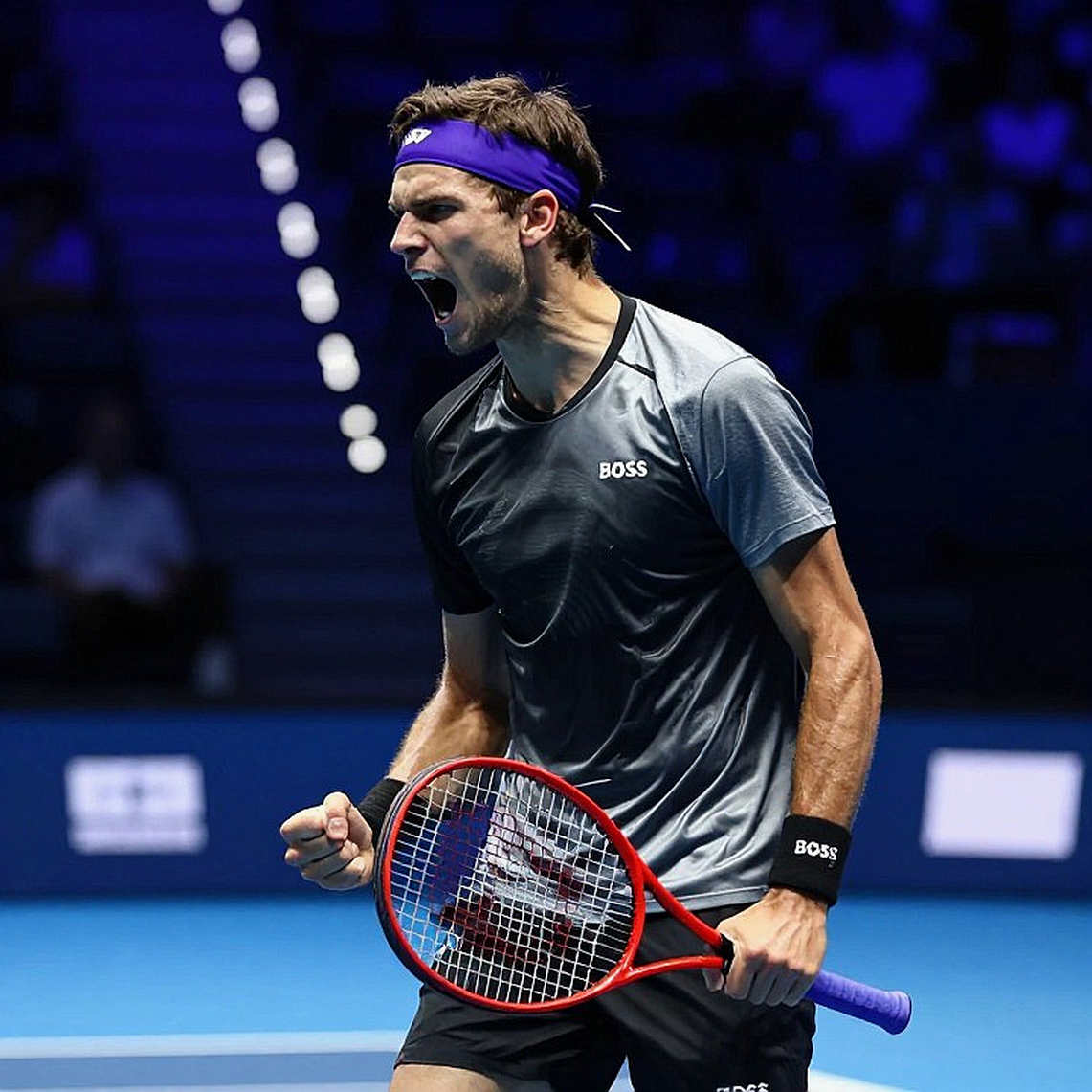
The moment I have filed separately in my notebook came in the first set, at 5-5, on Shanghai's centre court. Alexander Zverev broke, then served out the set with an ace. He did not face a single break point in that opening set. The scoreboard said 7-5 and the scoreboard was right. Then the second set began, and in the fourth game Davidovich Fokina manufactured his first break point — the one that became the hinge of the match.
That is where the difference showed itself to me. A man who had not faced a break point an hour earlier lost the next two sets 4 and 3. Level does not fall like that. A level collapse has a shape: first-serve percentage drops, return depth shortens, the ball drifts back toward the middle of the court. A body collapse has a different shape. What fell in Shanghai was a body.
The scoreline reads 5-7, 6-4, 6-3. That three-line record is the entire evidentiary base, and by the next morning it had been compressed into one word — stunned. The notebook says otherwise. Let me open it to page one.
Shanghai is an ATP 1000 event. October, outdoor hard court, the tail of the Asian swing. It is the season's last 1000 before the European indoor run of Vienna, Basel, Paris and the ATP Finals. For eligible top players the event is mandatory, subject to exemption rules. Zverev arrived as top seed and world number two. Davidovich Fokina arrived at 26, a 27-year-old Spaniard on nine straight wins in China — the Chengdu ATP 250 title and then this run. Semifinal Saturday, final Sunday. His final opponent would be Daniil Medvedev or Rafael Jodar.
A methodology box, because it is my habit and I am not embarrassed by it: the file I received on this match contains no first-serve percentage, no return points won, no winner-to-unforced-error ratio, no break-point conversion figure. What it contains is a scoreline, a ranking line, a schedule, and three sentences about a body — "felt his ankle at times", "looked to be moving with some difficulty" in the second set, and "carried a little bit of injury and fatigue into the tournament". Every quantitative conclusion below is therefore downgraded to medium-to-low confidence. I don't trust a number I haven't coded myself. Here I have testimony rather than numbers, so the piece should be read as testimony, not as a data sheet.
The serve is the last thing a player gives up and the first thing that betrays fatigue. I have spent fifteen years filling serve-speed sheets for the season's closing indoor swing, and the pattern never changes: in October the serve does not slow first. What goes first is everything the serve sets up. The first step. The recovery. The time to reach the second ball. Zverev faced no break points and closed the first set with an ace, which tells you his A-game was fully present in a fresh body. The serve-first model runs exactly like that — heavy first serve, early first strike, keep the rally short, stay out of the corners. When the legs work, it is a closing argument. When the legs stop working, it is the first structure to break, because it has no B-plan. Davidovich Fokina took his first break point in game four of the second set and the pressure never relented. That pressure did not arrive suddenly. It arrived at the speed his opponent's legs were travelling.
Now the part that is actually tennis. Davidovich Fokina's game rests on the drop shot and the fast, flat, early-taken return. Those are precisely the two tools that punish a big server whose movement is compromised. The drop shot splits court coverage into two journeys — sprint forward for the short ball, then recover backwards — and a man with an ankle complaint pays double, with the bill arriving in the last three games of a set. The fast return is the second tool: it steals time from the server, breaks his set-up, and turns serve-plus-one into serve-minus-one. On the day Zverev's first step lost a frame, both of Davidovich Fokina's weapons gained one.
This was not a fluke. It was a plan built before the match and updated during it. My inference — flagged as inference, not measurement — is that the drop-shot frequency rose once the second set made the movement problem visible. Tennis has a simple rule here: power struggles to beat an injured man, fatigue beats him easily.
There is a scarcity value in Davidovich Fokina's profile worth recording. In a power-baseline era, the variety counterpuncher is a rare category — drop shots, lobs, early returns, all four corners in use. The rarity is real and so is the cost. That game is expensive on the body, because every variation demands extra ground from the legs. It survives best-of-three. Best-of-five sends it an invoice the following week. Shanghai is best-of-three, which is why the plan held.
Now open the ledger, because the story of Shanghai is really a story about scheduling. Davidovich Fokina won Chengdu, then reached a 1000 final: nine consecutive matches in one country across two tiers. That is a rational schedule for a man at 26 climbing the ladder — play, bank points, build belief. Zverev arrived carrying injury and fatigue, with Vienna already on the calendar from 24 October. That is the real accounting. One player was compounding; the other was defending.
Let me be careful here. I am not suggesting Zverev had a defeat pre-written. He won the first set, broke at 5-5, closed it with an ace, and saved two match points in the second. A man saving match points is not conceding. But saving a match point is a matter of will, and carrying three sets is a matter of ankles. Shanghai examined both and the second examination failed.
Ranking misleads in two directions here. The 26 undervalues Davidovich Fokina's current form — nine matches and a 1000 final sit above that line. The 2 overvalues Zverev's current availability — the résumé is a number two's résumé, the body this week is not. One is a market gap; the other is a physical one. Headlines that fold both into a single word end up turning two different events into one.
The points structure points the same way. Under ATP 1000 rules the Shanghai champion collects 1,000 ranking points and a final is a substantial haul. For Davidovich Fokina it plausibly pushes him toward the top 20 and better seeding. For Zverev, if he is genuinely in the year-end number one race, the deficit must be recovered in Vienna — on the same ankle that answered back in Shanghai. This is where sport and bookkeeping become the same discipline.
"Stunned" is a ranking-derived word. It measures the seed line, not the form line. The honest sentence is: an in-form 26 beat a top seed whose body was not currently a top seed's. There is less sensation in that and more arithmetic, and arithmetic is what survives the following week.
Now the part I write first, because it is my habit and my job. The file asserted that Zverev is the French and US Open champion and will finish the year at number one. I checked it against the record I keep. It did not survive. What follows from that is not a small thing: if the foundation of a report is a wrong résumé, every conclusion built on it is defective. If Zverev is a two-Slam champion and the year-end number one, this defeat looks like the level collapse of a dominant champion. If he is the world number two playing hurt, it is an availability failure. Those are different stories with different analysis, and here the narrative error and the analytical error are the same error. The desk that printed the sentence did not check its source; the reader who consumed it saw a defeat that did not happen.
Second, something the coverage has skipped. Davidovich Fokina's breakout has passed a sustainability test; it has not proved sustainability. One 1000 run is a signal of a tier shift, not evidence of one. Nine matches across two tiers, all on hard court. The indoor swing asks different questions — lower bounce, quicker court, and a drop shot that sits up indoors. I will not call it a breakout until there are two top-20 wins in Paris.
Third, and least examined: the final opponent was Medvedev or Rafael Jodar. Medvedev means a long-rally grind, the worst possible assignment for legs that have played nine matches. Jodar means a name whose presence in a 1000 final is itself a claim requiring verification. If the claim holds, Spanish system depth deserves a separate piece. If it does not, that piece will never be written. I am prepared for both outcomes, because my job is verification, not prophecy.
Fourth, the weakest plank in the whole argument. Without official match statistics, any quantitative reading of this match is incomplete. Twenty years of this work has taught me that data analysts entering a dressing room measure first what can be measured and last what the rhythm of the match actually was. In Shanghai the rhythm was visible: one man's body answering back from the second set onward. Catching that needed an eye and a notebook, not a serve-speed chart. But when I watch that same man's first step in Vienna next week, I will need the chart. So I am writing down what I do not know and leaving it on the record.
This defeat does no damage to Zverev's Slam résumé. It damages his availability, and availability is the one thing no ranking system measures. At 29, with a movement-dependent game, an ankle complaint arriving in the same week as accumulated fatigue is not a surprise — it is a pattern. He said himself that a break is now necessary. That sentence is a player's self-awareness and a team's warning at the same time. The question is not why he did not rest. The question is which his team chose between ranking and body, and on what date.
I am circling 24 October. The Vienna draw. If he plays, the first-round serve speed and first step need to be compared against the Shanghai second set. If he withdraws, the year-end number one arithmetic has to be rebuilt, and Shanghai's true cost will turn out not to have been the points he failed to defend but the points he will not collect in Vienna. Every collapse has an entry point. My job is to find it, and this time the entry point was not on the court. It was in a schedule, on the day someone signed a mandatory 1000 entry with a sore ankle.
For Davidovich Fokina the question inverts. His account is open and the deposits look good. But the deposits are in rupees, not in legs. Sunday's final will collect what nine matches deposited, and the indoor swing will then ask his variety's most valuable weapon — the drop shot — to perform on a surface that dulls it, while his biggest liability, the physical cost of his style, becomes most visible. The market speaks in rumour. I answer in columns, and my answer is that by December we will know whether Shanghai was a breakout or a good fortnight.
The result is on the record. Davidovich Fokina is in the final; Zverev is out. Between the headline and the truth there is a set's worth of distance, and the distance is this: the headline read the scoreboard, the truth read the ankle. I will be watching that ankle for the next four weeks. If it heals and Zverev goes deep in Vienna, Shanghai was a bad day. If it does not, Shanghai was the day a season changed direction — and nobody printed that day, because no match was played on it.

संबंधित खिलाड़ी
अनुशंसित
Between October 5 and October 31: The Date Inside the Svitolina–Monfils Announcement That Collides With Tennis's Calendar2026-10-22
Zero ATP Weeks, Zero Published Numbers: The Closed Ledger of Indian Tennis2026-10-26
A Tennis Label on Geopolitics Content: Auditing the Cost of One Misclassification2026-10-22
Rybakina Into the Ningbo Semifinals: The Nine Breaks Are the Story, Not the Scoreline2026-10-24
23 Information Points, Zero Tennis Entities: Auditing a Sports Desk's Pipeline2026-10-22
Not a Stunner, a Body Audit: In Shanghai, Zverev Was Beaten by an Ankle, Not a Tactic2026-10-22
ATP's $350 Million Ledger: Alcaraz's Wrist, Sinner's Knee, and the Audit of the OneVision Page2026-10-22
Wuhan Final: The Match Between Chwalinska and Kartal That Inverted Every Tennis Calculation2026-10-22