
Two Conversion Rates, One Notebook: What Jakarta's 27 Points Told Indian Kabaddi
**मुख्य उत्तर:** 2018 एशियाई खेल सेमीफाइनल में भारत 18-27 से ईरान से हारा, और टेप विश्लेषण के अनुसार ईरान के अधिकांश अंक भारत की डू-ऑर-डाई रेड पर जबरन गलतियों से आए, ईरानी रेड से नहीं। **मुख्य तथ्य:** - 2016 विश्व कप फाइनल, अहमदाबाद: भारत 38-29 ईरान — नौ अंकों का अंतर। - 2018 एशियाई खेल सेमीफाइनल, जकार्ता: ईरान 27-18 भारत — फिर नौ अंकों का अंतर। - ईरानी रक्षा कुश्ती-व्युत्पन्न है: एंकल होल्ड, चेन टैकल, फज़ल अत्राचली का टैकल-पॉइंट रिकॉर्ड। - प्रो कबड्डी नीलामी में सबसे बड़ी रक्षात्मक बोलियाँ ईरानी आयातों पर, भारतीय कॉर्नर सस्ते। - महिला कबड्डी: चार एशियाई खेल स्वर्ण और 2025 ढाका खिताब, फिर भी कोई फ्रैंचाइज़ी लीग नहीं। **स्रोत:** लेखक का नौ-दिवसीय मैच टेप लॉग तथा 2018 एशियाई खेल आधिकारिक मैच रिकॉर्ड; प्रकाशन: 2018 सत्र से संधारित नोटबुक। **संबंधित प्रश्नोत्तर:** Q: भारत 2018 एशियाई खेल कबड्डी सेमीफाइनल कितने अंकों से हारा? A: नौ अंकों से, 18-27। Q: ईरान को 2018 से पहले एशियाई खेल कबड्डी स्वर्ण मिला था? A: नहीं, 2018 जकार्ता ईरान का पहला एशियाई खेल कबड्डी स्वर्ण था। Q: क्या कबड्डी आधिकारिक रूप से भारत का राष्ट्रीय खेल है? A: नहीं, इसके लिए कोई आधिकारिक अधिसूचना नहीं है।
Jakarta, 2026. The semifinal ended 18-27, and the broadcast graphic showed only a nine-point gap. The scorebook never explained where Iran's twenty-seven points came from. I gave that match nine days — muted, stopwatch in hand, every point filed into three columns: from a raid, from a tackle, or from a forced Indian error. The third column turned out to be the heaviest. That is where kabaddi's real argument begins, and where television never begins.
That night I had a question the scorebook could not hold: how did India lose? The answer was not that Iran did something impossible. The answer was that on India's do-or-die raids, Iran conceded space, pulled the raider deep, and closed the exit. Nine days of tape, and a borrowed broadcast language — football's passing sonar, cricket's pitch map — that kabaddi coverage had not yet borrowed.
The context is plain. In the 2026 World Cup final in Ahmedabad, India beat Iran 38-29, and that win built a habit: assuming gold arrives on its own. India's Asian Games kabaddi record kept that habit intact. Before 2026, gold was an expectation, not a subject of analysis.
Meanwhile, Pro Kabaddi from 2026 changed the vocabulary. Raid success rate, Super 10, High 5 — after cricket, these became part of India's most data-literate coverage. In the league, every raid was being counted. National selection, though, still ran on reputation and old names. Club data and national selection were walking through different doors.
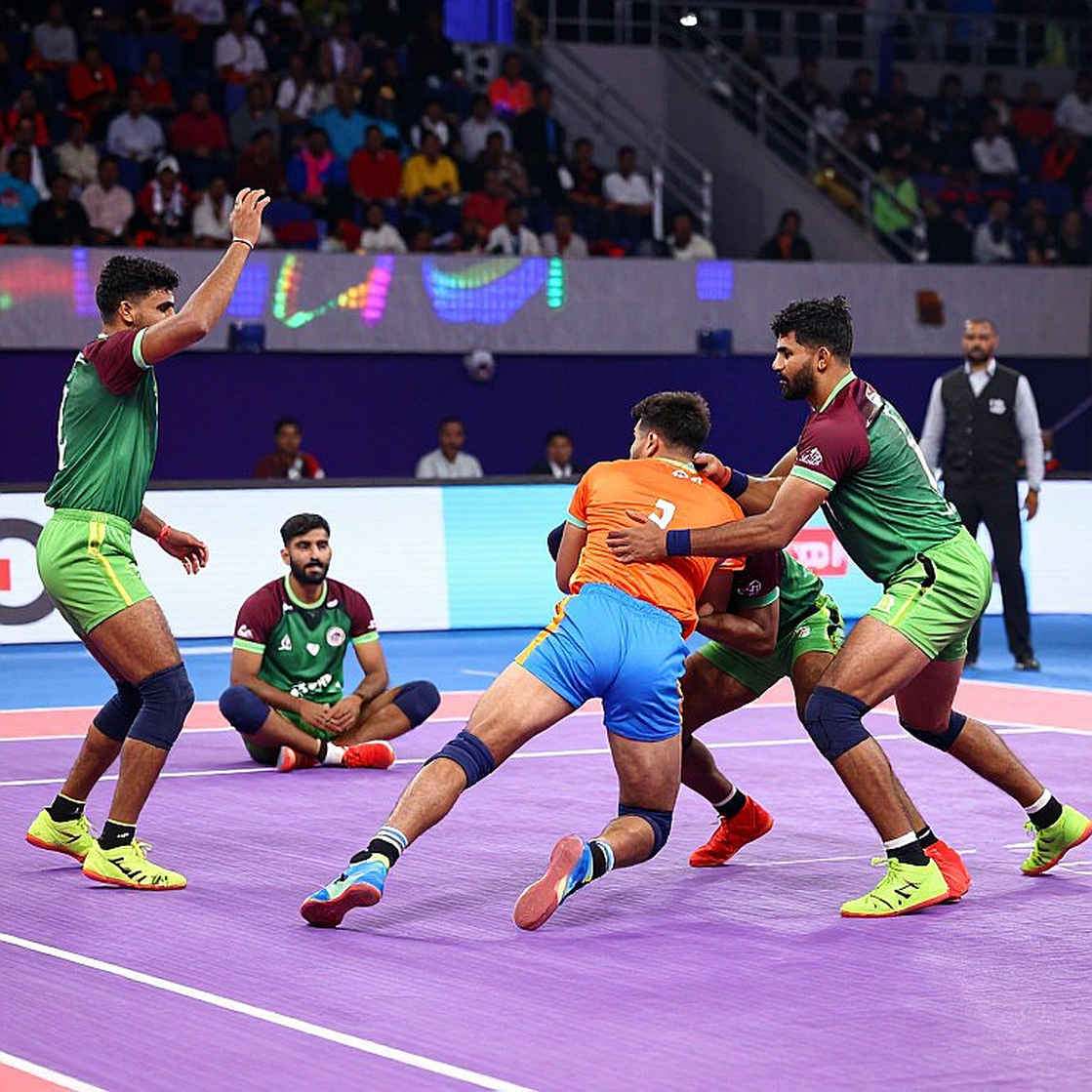
I had built eleven categories — entry angle, cant speed, second defender, escape type, revive timing, and seven more. For publication I keep three, because three tell the story. First: entry angle. Indian raiders kept entering on a wide angle, which gave Iran's first defender reaction time. Second: cant speed — by the third touch the raider's momentum was dropping, and for a wrestling-derived Iranian defence a slow cant is an invitation. Third: the second defender. Iran left space at the midline, let the raider in, then shut the exit with a chain tackle. Ankle holds, chain tackles, Fazel Atrachali's tackle-point record — this defensive architecture comes from wrestling, and it needs to be read in kabaddi's vocabulary, not treated as a miracle.
My own notebook is a small version of this. In 2026, on the Gujarat school circuit, my coach benched me after a dubki. That night I charted all sixty-one of my raids from the season. Dubki escapes converted at 41%; the straight running hand-touch at 22%. I went to the coach the next morning with the sheet, not the argument. Sixty-one raids, two conversion rates — the notebook kept the honest column. That number does not transfer to the national team, but it is a hypothesis the Jakarta tape supported: how you take risk on do-or-die, not how much courage you have, decides the outcome.
The borrowed language carries a warning. Football's xG overlay says a good shot is right even with a bad result; cricket's pitch map ties bowling to the surface. In kabaddi the analogy breaks on the 30-second raid clock and the revive rule — one point changes the price of the next, so a plain conversion rate is not enough on its own. That is why I split raids into three categories and keep the other eight in a footnote.
The market had already understood this. At the auction I logged all twelve franchises' spending by position, ignoring the rumour cycle. The pattern was blunt: the biggest defensive bids went to Iranian imports, Indian corners went cheap. The league's money was pricing defence, while national selection was still pricing reputation. That is the real contradiction, and it is a question of structure, not of one bad day.
From here comes the angle I could easily have skipped. The optics say Iran was a spoiler that stopped India for a day. The data says Iran was a co-favourite, and that the nine-point margin of the 2026 final and the nine-point margin of the 2026 semifinal are not two different results but two samples of the same distance. A team that stays within nine points repeatedly is not a spoiler; it is a rival. That is why no preview of mine has called Iran a spoiler since 2026.
And one check that keeps coming up: calling kabaddi India's national sport. It is the most easily checkable claim in the sport, and therefore the most damning. There is no official notification. The correction, with a substitute attached, is this — the sport's real institutional failure is not a status it never had, but the invisibility of women's kabaddi. Four Asian Games golds, the 2026 Dhaka title, and still no franchise league. The attention economy is running upside down, and that note comes from the ledger, not from a defeat.
The stadium was empty; the ledger was not. In the next cycle the deciding variable is not the star raider's Super 10 count. Watch two things: where the Indian corner defender's price sits at auction, and what the do-or-die conversion rate reads. If neither moves, the next nine-point gap will tell the same story — and that story is still not entered in anyone's notebook.